Teen Patti Master: Rules, Strategy & Winning Tips
Last updated 11 Jun 2026
Teen Patti Master is one of India's most widely played online card games, drawing from the centuries-old tradition of Teen Patti, a game deeply embedded in Indian social culture, particularly during festivals like Diwali. The digital version brings that same competitive energy into a format played by millions daily across mobile platforms.
This guide is written from hands-on experience analyzing hundreds of game sessions, studying betting patterns, and reviewing the mechanics across multiple Teen Patti variants. Whether you are just starting out or looking to sharpen your edge at the table, everything here is grounded in how the game actually plays, not theory alone.
Disclaimer: Yono Store is an independent app discovery and information platform. The content on this page is intended for informational and entertainment purposes only. We do not promote, endorse, or facilitate real-money gambling or any activity that violates applicable laws. Teen Patti Master and all games listed on this platform are the sole responsibility of their respective developers. Users are advised to review the laws and regulations of their state or region before downloading or playing any app. If you are under 18, please exit this page. Play responsibly.

Signup Bonus
₹60
Min. Withdraw
₹100
Downloads
135M+
Rating

Stay Connected with Yono Store
Get instant updates, new app releases, exclusive bonuses, and withdrawal proofs directly from Yono Store!
Join Our Telegram ChannelWhat Is Teen Patti Master?
Teen Patti Master is a digital adaptation of the classic Indian card game Teen Patti, which itself shares roots with the British game Brag and bears strong similarities to Three-Card Poker. The word Teen Patti translates directly to "three cards" in Hindi, which defines the core format of the game.

In the online version, players compete in real time against others, placing bets across multiple rounds while managing limited information. You either play without seeing your cards (blind) or after viewing them (seen). The goal is to either hold the best three-card hand at showdown or outlast every other player through smart betting.
What separates Teen Patti Master from pure luck-based games is the strategic layer: reading opponents, managing chip stacks, choosing when to bluff, and understanding probability over time all have a measurable impact on results. If you want to explore and compare other popular card game apps, check out Teen Patti Gold, Teen Patti Bodhi, and the New Teen Patti Master version listed on Yono Store.

Signup Bonus
₹70
Min. Withdraw
₹100
Downloads
55M+
Rating

Signup Bonus
₹70
Min. Withdraw
₹100
Downloads
49M+
Rating
Teen Patti Master Rules: Full Breakdown
How a Round Works
-
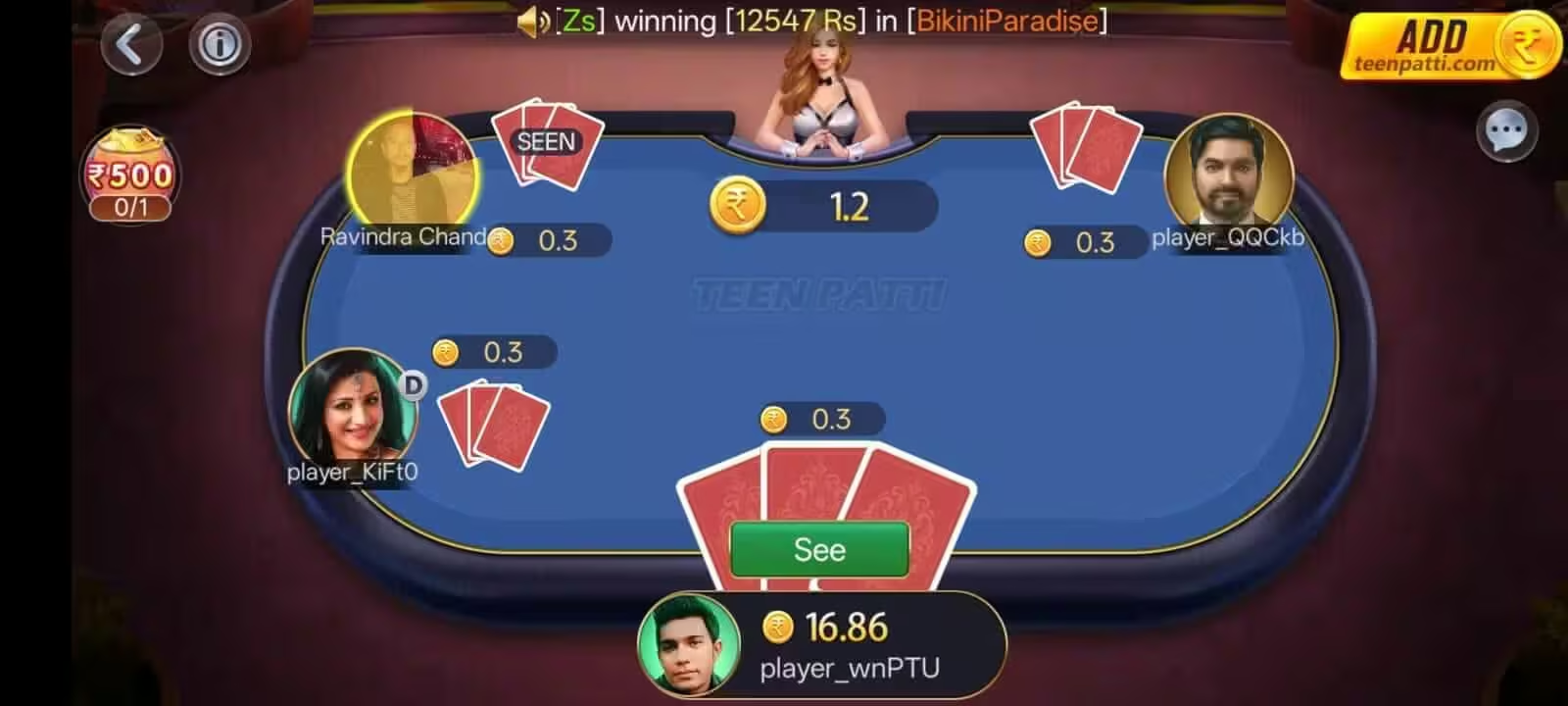
Boot Amount: Before cards are dealt, every player at the table contributes a fixed minimum bet called the boot, which seeds the pot.
-
Card Deal: Each player receives exactly three cards face down from a standard 52-card deck. No wild cards exist in the base game (variants change this).
-
Betting Order: Starting from the player to the dealer's left, each player must either bet or fold on their turn. You cannot check (pass without betting) in Teen Patti.
-
Blind vs. Seen Play
- Blind players have not looked at their cards. Their minimum bet is the current stake; their maximum is double.
- Seen players have viewed their cards. Their minimum bet is double the current stake; their maximum is four times.
- Playing blind keeps your bet cost lower but reduces your decision-making information.
-
Requesting a Show (Sideshow / Compromise)
- A seen player can request a sideshow with the previous seen player, privately comparing hands. The weaker hand folds.
- The final showdown happens when only two players remain, or when one requests a show.
-
Winning: The player with the highest-ranked hand at showdown wins the entire pot.
Hand Rankings (Highest to Lowest)
Understanding these rankings is non-negotiable. Memorize them before your first session.
| Rank | Hand Name | Description | Example |
|---|---|---|---|
| 1 | Trail / Trio | Three cards of the same rank | A♠ A♥ A♦ |
| 2 | Pure Sequence | Three consecutive cards, same suit | J♠ Q♠ K♠ |
| 3 | Sequence / Straight | Three consecutive cards, mixed suits | 9♠ 10♥ J♦ |
| 4 | Color / Flush | Three cards of the same suit, non-sequential | 2♣ 7♣ K♣ |
| 5 | Pair | Two cards of the same rank | 8♠ 8♥ 3♦ |
| 6 | High Card | No combination; highest card wins | A♠ 9♦ 4♥ |
Tiebreaker rule: When two players hold the same hand type, the higher-ranked cards within that type win. For a pair, the higher pair wins; if pairs are equal, the kicker (third card) decides.
Ace flexibility: In sequences, Ace can function as the highest card (A-K-Q) or the lowest (A-2-3), giving it unique tactical value.
All Major Teen Patti Master Variations
Variations are where strategy depth multiplies. Each format demands a different approach.
AK47
All Aces, Kings, Fours, and Sevens are wild jokers. With this many wilds in play, strong hands appear more frequently, which inflates the pot and makes folding weaker hands even more important. Strategy shift: Play tighter since your opponents' average hand strength rises significantly.
Joker (Random Joker)
One or more random cards are designated as jokers at the start of each round. The joker card and all cards of that rank become wild. Strategy shift: Identify the joker early and reassess your hand strength relative to how many potential wilds are now in the deck.
Muflis (Lowball)
Hand rankings are completely reversed. The weakest hand in standard Teen Patti becomes the strongest here. A high-card hand can beat a Trail. Strategy shift: Pursue low, unconnected cards. Fold aggressively if you are dealt a pair or better in the opening hand.
999
Players aim for a three-card combination totaling as close to 999 as possible, with face cards counting as 9. Strategy shift: Mathematical calculation replaces hand-ranking intuition. Practice rapid mental addition.
2 Cards Open
Two of the three cards are visible to all players from the start. Strategy shift: Decision-making becomes more analytical since shared information reduces uncertainty. Bluffing is harder and reading opponents becomes more important.
Best of Four
Players receive four cards but must form their best three-card hand. Strategy shift: Hand potential increases for everyone, so the bar for staying in a round rises.
Proven Winning Strategies
1. Play Fewer Hands, Play Them Harder
The single most common mistake among losing players is entering too many rounds. The dealt cards in a given session follow statistical distributions, and fighting poor starting hands repeatedly bleeds your stack steadily.
Practical rule: If your three cards form no combination and your highest card is below a Jack, consider folding unless you are in a blind position with minimal pot investment.
2. Use the Blind Position Deliberately
Playing blind is not reckless. It is a tool with real tactical value:
- Your bets cost half of what seen players pay, letting you apply pressure cheaply.
- Opponents cannot use your betting size to read your hand strength.
- It creates psychological uncertainty across the table.
When to switch to seen: When the pot has grown large enough that the cost of staying blind starts to outweigh the benefit, or when you are one of the last three players.
3. Bet Sizing as Information Control
Every bet you make communicates something. Skilled players use sizing to either extract information or withhold it.
- Large bets signal strength or simulate it (bluff). Use them sparingly so they carry weight.
- Consistent bet sizing across strong and weak hands makes you harder to read.
- Minimum bets on strong hands (slow play) can keep weaker opponents in the pot longer, building a larger win.
4. Bluffing: Frequency and Context
Bluffing works when it is credible, meaning your betting history at that table supports the story you are telling with your chips.
Bluff when:
- You have been playing conservatively and your opponents have noticed.
- The board texture (in open-card variants) supports the strong hand you are representing.
- You are facing one opponent, not three or four.
- The pot is not yet so large that opponents feel committed to call.
Do not bluff when:
- A player has been calling nearly every bet, they are not folding.
- You have recently been caught bluffing at the same table.
- You are playing Muflis, where standard hand-strength signals are inverted.
5. Sideshow Strategy
Requesting a sideshow is a precise move. Use it when you hold a strong hand and want to eliminate a dangerous opponent privately, or when you want to apply pressure on a player you read as weak. Decline sideshows when you are holding a marginal hand that is better served by staying in the main pot.
Probability and Odds Reference
Understanding how rare certain hands are helps you make proportional decisions about aggression.
| Hand | Approximate Probability |
|---|---|
| Trail (Trio) | 0.24% |
| Pure Sequence | 0.22% |
| Sequence | 3.26% |
| Color (Flush) | 4.96% |
| Pair | 16.94% |
| High Card | 74.39% |
Key insight: Nearly three out of four hands dealt are high-card hands. This means most rounds are won not by the player with the best cards but by the player who applies the best pressure at the right moment. Probability supports an aggressive, selective approach over a passive one.
Bankroll Management
No strategy survives poor bankroll management. This is the structural foundation every other skill is built on.
- Session limit: Set a fixed amount before you sit down. When it is gone, the session ends with no exceptions.
- Single-round limit: Do not commit more than 5 to 10% of your session bankroll to a single round unless you have a top-tier hand in a late-stage pot.
- Stop-loss discipline: If you lose 30 to 40% of your session bankroll, stop. Attempting to recover losses in the same session leads to deteriorating decision quality.
- No emotional top-ups: Adding funds mid-session after a loss solely because of frustration is one of the clearest signs of unsustainable play.
- Win targets: Decide in advance what a successful session looks like, a 20% or 30% gain on your session stack for example, and leave when you hit it. Greed at the table converts winning sessions into losing ones.
For a broader look at skill-based gaming discipline and safe platforms, the gaming app safety guide and the list of safest Indian gaming apps on Yono Store are worth reading alongside this guide.
Reading Opponents: Behavioral Signals
In digital Teen Patti, behavioral tells come from betting patterns rather than physical cues.
| Signal | Common Interpretation |
|---|---|
| Instant large bet | Strong hand or practiced bluffer |
| Delayed bet after hesitation | Uncertainty or weak hand |
| Consistent minimum bets | Conservative player or slow-playing strong hand |
| Sudden large bet after small bets | Potential bluff or hand improvement in open variants |
| Frequent sideshow requests | Aggressive player testing opponents |
| Accepting every sideshow | Confident in hand strength |
Important caveat: No single signal is definitive. Patterns matter. Track a player across three to four rounds before drawing conclusions about their tendencies.
Common Mistakes to Eliminate
Playing Too Loosely Early
New players often play every hand to see what happens. This slowly empties the stack. Discipline in hand selection is more valuable than courage in weak spots.
Bluffing Too Frequently
Bluffing is most effective when rare. A player who bluffs repeatedly loses credibility quickly. Opponents stop folding and start calling, eliminating the bluff's core value.
Ignoring Bet Sizing Tells
Your own bets tell a story. If you always bet big with strong hands and minimum with weak ones, experienced opponents will map your pattern within a few rounds.
Chasing Losses
One bad round does not define the session. Making larger, riskier bets to recover a loss rapidly accelerates the downswing. Treat each round as independent.
Neglecting Variation Rules
Jumping into a Muflis or 999 round with standard-game instincts is one of the fastest ways to lose chips. Confirm the variation before committing your boot.
Play Responsibly
Teen Patti Master is meant to be enjoyable. Keep it that way by setting a fixed budget before every session, taking regular breaks, and never chasing losses. Do not play under emotional stress or use money reserved for essentials. If gaming starts feeling compulsive or stops being fun, take a break and seek support. Play smart, play safe.
Final Thoughts
Teen Patti Master rewards players who treat it as a discipline rather than a gamble. The structural advantages available to any player, selective hand play, blind-position tactics, controlled bet sizing, and pattern-based opponent reading, are accessible regardless of experience level. They simply require consistency.
The players who lose consistently share a shorter list of habits: playing too many hands, bluffing without context, and abandoning their limits during losing streaks. Avoiding those three patterns alone puts you ahead of the majority of players at most tables.
Start with the fundamentals. Apply them consistently. Adjust based on what the table shows you. To explore more verified card game apps and stay updated on the latest gaming releases, visit Yono Store and browse the full catalog including all Yono games and the most rated apps.
Frequently Asked Questions

I have spent over 4 years reviewing real money gaming apps across India, with a focus on rummy platforms and withdrawal reliability. I test every app I write about, from signup bonuses to cash-out speed, so readers get honest guidance before they deposit a single rupee.